
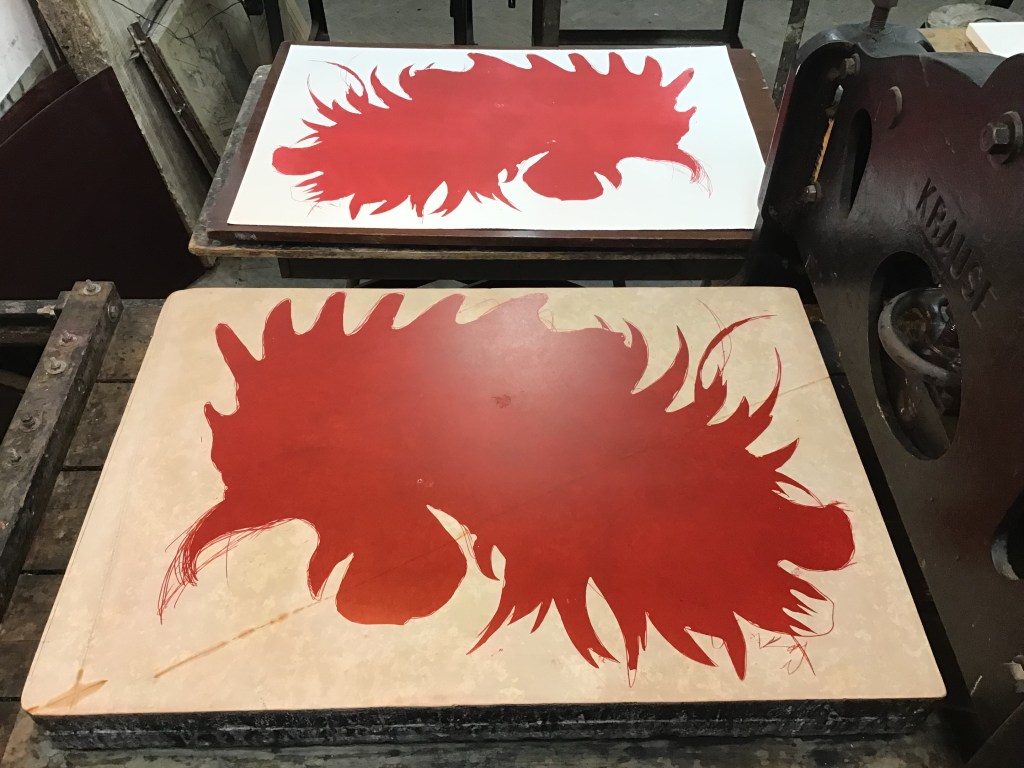
Lithography was invented by Alois Senefelder at the
end of the 18th century in Munich.
During the Napoleonic Wars, the new techniqe quikly spread throughout Europe.
Artist such as Francisco Goya, Henri de Toulouse Loutrec, Pablo Picasso, Jean Miro worked in this techniqe.
Currently lithography is almost completely forgotten and is on
the list of disappearing professions UNESCO
The lithography technique offers a very wide spectrum of artistic expression. The artist working in it can achieve both subtle tonal transitions and contrasting spots or precise lines. Lithography also gives you unlimited possibilities to manipulate color. It allows the use of many glaze layers in order to obtain the appropriate depth and color saturation, it also allows you to build an image from flat color patches, use gradients and strong contours.
Lithography is a graphic techniqe based on the balance of three elements:
stone, grease and water.
Stone
A drawing is made on the sanded surface of a special type of limestone, called
lithographic stone
Grease
The main component of drawing materials used in lithography is grease.
After drawing grease penetrates into the stone structure, permanently changing the properties of the surface on wchih it is located
Water
When the stone is redy to accept the printing ink it is moistened with water.
The parts covered with the driwing (which was made with greasy drawing materials) repel water that collects where there is no grease. The ink is applied with a leather roller. As long as the stone remains wet, only greasy places take printing ink, the remaining areas are protetced by water.
The prints are made on lithographic press. Printing ink from stone goes to paper under a pressure of about 300 kg. Such a large pressure also makes the uniqe twxture of the stone imprint on the papaer, which can be seen under high magnification.
The edition is all prints signed by the artist. They are printed by the author or under his strict supervision. The print is described by two numbers that are divided by a slash and look like a fraction. The number below the slash is the size of the edition and the upper number is the number assigned. All prints described and signed by the author are originals.
When printing, the artist tries to make all prints the same. However, the fact that it is an manual printing determines the slight differences between the prints. Although all the prints are the same, everyone is different.
By making an analogy with diferrent filed of art, each of the prints is like a separate performance of the same musical composition
 runolitograf.com